


Current Applications, Challenges & Future Impact

The mortgage servicing industry has lived with the reputation of being technologically sluggish due, in part, to reliance on legacy systems, compliance overhead, and regulatory scrutiny, among many other factors. But over the past five years, two disruptive forces have begun to reshape this landscape with unprecedented speed: artificial intelligence (“AI”) and blockchain technology. These two technological advances have, no doubt, infiltrated nearly every aspect of our lives, often without us knowing. It seems that the same can now be said about the use of these powerful technologies in mortgage servicing. Their adoption levels vary, but the direction is clear: Both technologies are becoming increasingly relevant to how servicers manage customer interactions, handle documents, comply with regulations, and transfer or value mortgage servicing rights.
As we look across the continuum of origination, onboarding, escrow management, default servicing, investor reporting, and MSR trading, the question is no longer whether AI and distributed ledgers will influence the industry. It is whether mortgage servicers will embrace transformation fast enough to avoid being overtaken by those who do. These technologies may ultimately redefine everything from how borrowers interact with their servicers to how mortgage assets are traded, verified, and valued on global markets.
AI in Mortgage Servicing
As explained during this year’s Executive Servicer Summit (“ESS”), compliant AI use in default law practice comes in many different forms. Generative AI creates new content such as pleadings or legal summaries based on large language models; predictive analytics AI uses historical data and algorithms to forecast outcomes; and automation AI executes repetitive, rules-based tasks without the need for the system to “learn” or generate new content.
There are some obvious examples of how AI can enhance customer experience and reduce costs. AI can be an excellent tool for customer interaction by automation of high-volume phone calls. This automation has the potential to provide round-the-clock service with reduced wait times and accurate conveyance of requested information while avoiding communication pitfalls that would run against federal regulatory acts. AI can also increase efficiency and reduce human error regarding document-understanding systems. Imagine a system that can instantaneously assess and reveal incomplete or inaccurate fields in borrower assistance packages. The time and cost savings are, indeed, immense. Each of these advancements come with the benefit of reduced labor costs and administrative expenses.
One of the not-so-obvious examples of how AI can improve mortgage servicing is risk prediction. AI models use historical data, macroeconomic variables, and overall borrower behavior trends to predict probability of delinquencies, borrower responsiveness, cure rates, and optimal loss-mitigation paths. These systems have the potential to help mortgage servicers reduce defaults while enhancing regulatory outcomes. Enhanced regulatory outcomes are the result of using systems that analyze servicing actions in both real time and retrospect. A system that can guide the actions of mortgage servicers in light of updates to CFPB guidelines as well as state-level requirements provides a way to demonstrate consistent, traceable, and explainable adherence to these complex rules.
The highly regulated nature of the mortgage industry means AI systems must strictly adhere to federal and state compliance laws. One of the challenges of incorporating AI into existing legacy systems concerns predictive behavior models based on historical data that may not paint an accurate picture. AI models trained on said historical data may perpetuate or even amplify existing biases, leading to discriminatory lending decisions and severe regulatory penalties. The more obvious concern relates to the need for heightened and robust security measures to minimize exposure to sophisticated fraudsters. Mortgage servicing involves vast amounts of sensitive personal and financial data. AI systems require access to this data, increasing the potential for data breaches, cyberattacks, and privacy violations. While AI can help detect fraud, it also enables more sophisticated fraudulent activities, such as the creation of convincing deepfake identities or fabricated financial documents, requiring enhanced verification protocols to counteract.
Furthermore, overdependence on AI without adequate human oversight or backup plans creates operational risk if a critical system fails. System failures can come in many forms considering AI models are only as good as their input data. Using poor-quality or insufficient data can lead to inaccurate models or the above-stated biased outcomes. Often the system itself is the issue. If a large language model has been improperly coded for its contextual use, the possibility exists for the system to generate “hallucinations.” This has happened many times with lawyers who use AI to generate a legal brief, submit said brief without checking the case cites, and then are sanctioned by the judiciary upon learning that the embedded case cites were fabricated by the system. The need for human oversight when implementing these systems cannot be understated.
As discussed at ESS, if AI detects rising frustration in a borrower’s voice during a call, the system can automatically escalate the case to a supervisor. If AI is tasked with generating a legal pleading or even a payoff statement, oversight by a qualified or licensed professional is required by governing authorities. Finally, if AI reviews past interactions and flags a borrower as a “high litigation risk,” the system should limit communications with the borrower and escalate all future interactions to the appropriate person in legal.
Blockchain Technology in Mortgage Servicing
The implementation of blockchain technology in mortgage servicing has been a slow, yet transformative change in industry standards. Most people associate blockchain technology with cryptocurrencies. While many servicers are beginning to embrace the idea of cryptocurrencies, blockchain technology can extend beyond this context alone. A blockchain-based loan record creates a unified stream of data anchored by a distributed ledger that is accessible only to permissioned participants. This chain of custody synchronizes updates across systems with reduced data disputes during servicing transfers and faster resolution of investor reporting discrepancies. User-based errors, such as missing documents or manual escrow balances, can become a thing of the past. If a particular account becomes the subject of litigation, a transparent, immutable history of servicing is worth its weight in rare earth minerals.
Another blockchain-based concept that financial institutions are beginning to explore relates to converting traditional mortgages or pools of mortgages into digital tokens on the blockchain. Tokenization of mortgage assets creates tokens that represent ownership rights to the underlying assets in an effort to improve efficiency and accessibility in the mortgage market. Efficiency comes in many forms: automatic carrier policy updates, easy disbursement executions, and real-time escrow activity that can be viewed by the borrower. Accessibility also comes in many forms: increased liquidity, the possibility of fractionalized ownership of servicing rights, and transparency for potential investors.
As one might expect, when legacy systems clash with technology that is, arguably, in its infancy, many challenges will arise. The legal framework for tokenized assets is still evolving, and issuers must navigate complex securities laws and other regulations in order to make the best use of this technology. There also exists the need for robust security measures in order to minimize exposure to sophisticated hackers and minimize system glitches.
Where AI and Blockchain Intersect
As may be predicted, these two powerful technologies may be combined to create multiplicative effects. AI can analyze blockchain-anchored data with confidence that it’s complete while the blockchain can record AI-generated decisions, creating auditable trails. This synergy gives regulators and investors a new level of confidence in automated servicing processes. AI models can feed predictive outcomes into blockchain-executed smart contracts. For example, if a borrower is predicted to enter hardship, the contract could pre-authorize certain outreach or modification options and loss-mitigation waterfalls could execute based on verified conditions and AI-generated probability curves.
AI-based servicing actions, such as recommending a modification path or triggering proactive outreach, can be recorded on a blockchain to produce a transparent audit log. Regulators and investors can review these logs to understand the basis for decisions and verify compliance. When smart contracts on the blockchain are integrated with AI outputs, they can automate servicing tasks based on predictive insights. Said servicing tasks can include automatic loss mitigation offers based on eligibility criteria or something as simple as initiating a payment reminder.
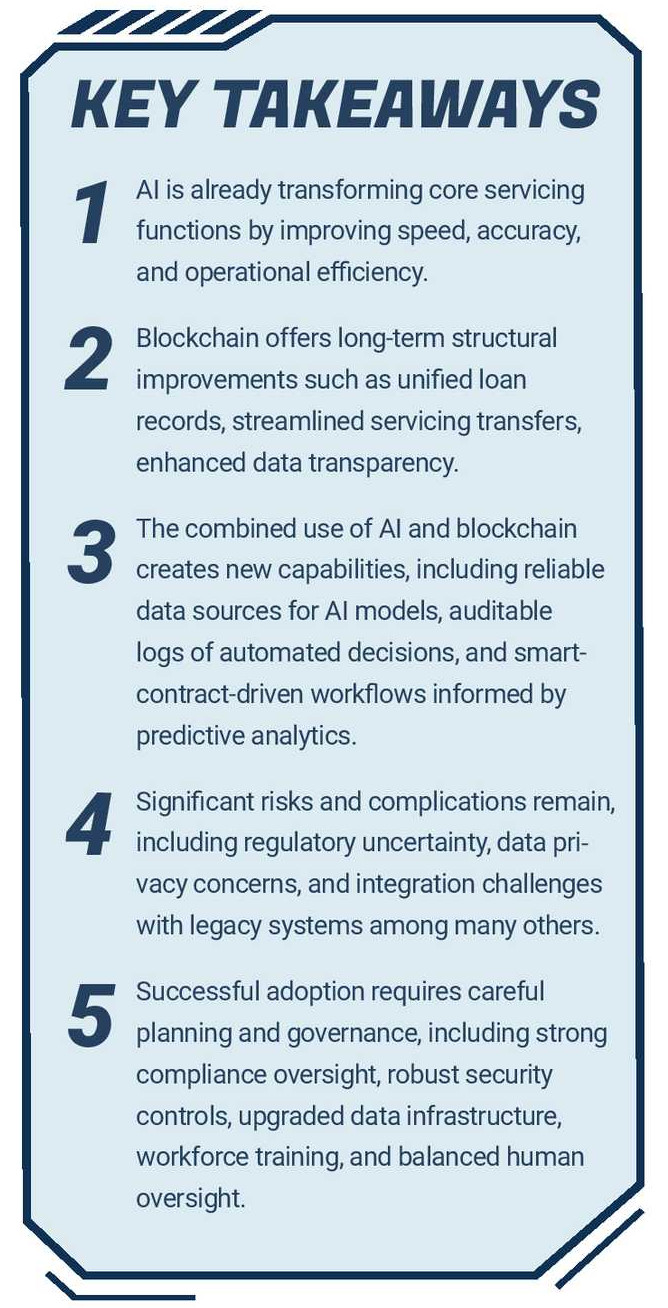
The combination of AI and blockchain technologies can significantly improve efficiency, accuracy, and transparency in mortgage servicing. However, their adoption also introduces material risks across compliance, privacy, infrastructure, and operational domains. Servicers should approach implementation methodically, prioritizing strong governance, clear auditability, regulatory alignment, and balanced human oversight. Addressing these considerations early will support responsible adoption and reduce the likelihood of unintended consequences as these technologies continue to evolve.
Conclusion
The mortgage servicing industry is facing a dramatic technological shift in the coming years. AI is already improving customer service, document handling, risk assessment, and compliance monitoring. Blockchain adoption is more gradual but presents significant potential in areas such as servicing transfers, escrow management, loan data verification, and asset tokenization. Their intersection offers an entirely new operating paradigm. As adoption increases, the intersection of these technologies may introduce additional capabilities, including more reliable data for AI models, automated workflows executed via smart contracts, and enhanced auditability. While challenges remain — particularly around regulation, data privacy, legacy systems, and workforce readiness — the long-term trajectory points toward a more automated and transparent servicing ecosystem.
The Author
BENJAMIN P. MAYER, ESQ.
Managing Attorney, Litigation

